
Categories
Market UpdatePublished July 16, 2026
Why Did My Austin Home Insurance Premium Jump in 2026, and What Can I Actually Do About It?

Why Did My Austin Home Insurance Premium Jump in 2026, and What Can I Actually Do About It?
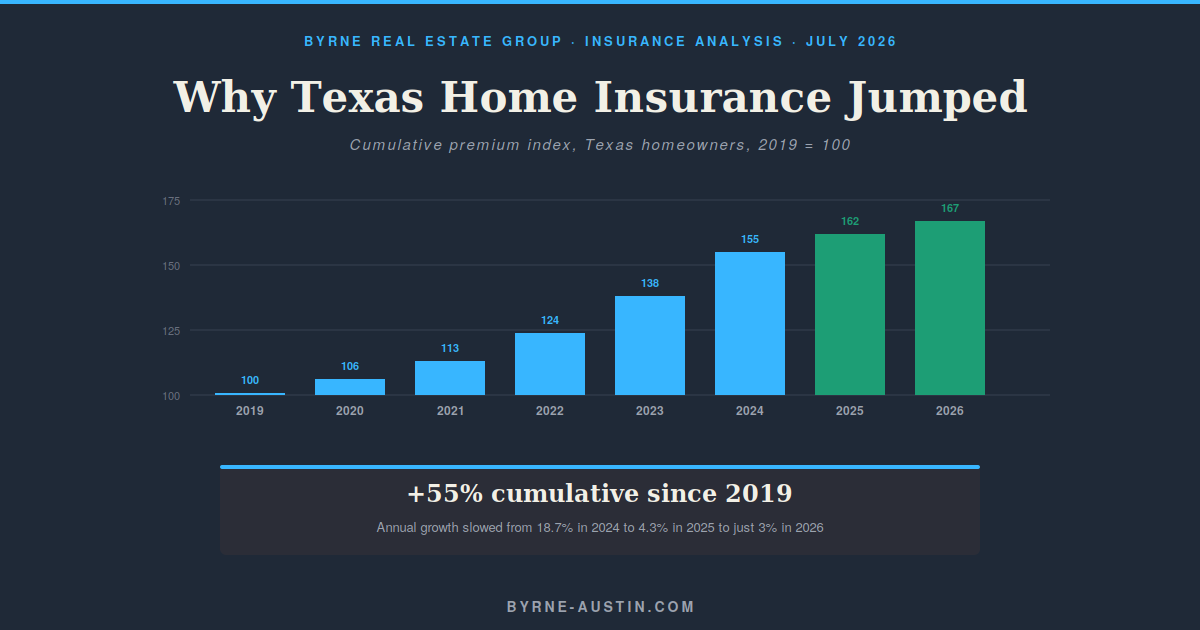
Texas home insurance rates are up 55%+ since 2019. Here's what's driving it, where rates are headed, and the practical steps that actually lower your premium.
By Clay Byrne, Founder of Byrne Real Estate Group ยท July 2026
Austin homeowners insurance averages $2,698 per year in 2026 for $300,000 in dwelling coverage... $123 above the national average and up more than 55% since 2019. The main drivers are rising construction costs, more frequent hail events, and rapidly appreciated home values requiring larger coverage limits. The good news: rate growth has slowed dramatically from 18.7% in 2024 to 4.3% in 2025, with 2026 projected at just 3%. Below are seven concrete steps every Austin homeowner can take to lower their premium at renewal.
If your Austin home insurance premium jumped again this year and you're wondering what happened... you are not alone, and it is not your imagination.
Home insurance rates in Texas have risen faster than in almost every other state. The average Austin homeowner is now paying somewhere between $158 and $217 per month for coverage on a typical home... roughly $1,900 to $2,600 per year. For higher-value homes across Westlake, Rollingwood, Barton Creek, Circle C Ranch, and similar communities, that number can easily exceed $4,000 to $6,000 per year.
The frustrating part is that most homeowners have no idea why. They just see the renewal notice, feel the sticker shock, and reluctantly pay it because they need coverage to keep their mortgage in good standing.
Here is the actual story of what happened, where rates are going next, and what you can do about it.
Why did my Austin home insurance premium jump in 2026?
Quick answer: Austin home insurance premiums have jumped because Texas has experienced a compound increase across three separate cost drivers... rising construction costs, more frequent and severe hail events, and rapid home value appreciation that requires larger dwelling coverage limits. Over the past five years, these three factors have driven Texas home insurance rates up more than 55%.
If you feel like your home insurance renewal keeps climbing, it is because it does. Every year. Rates in Texas have been increasing significantly for five straight years, driven by three factors that have all moved in the wrong direction at the same time.
First, construction costs. When your insurance company underwrites your policy, they are calculating what it would cost to fully rebuild your home if it burned down or was destroyed. Construction labor and material costs have risen substantially since 2020, which means the number your insurer needs to protect has grown even if your home has not changed.
Second, climate and weather risk. Central Texas averages three to five significant hail events per year, and each one generates widespread roof damage claims that insurers must pay out. Add severe thunderstorms, wildfire risk in the Hill Country, and increased flooding risk across the region, and insurers have raised rates to keep up with the actual cost of claims.
Third, and this one hits Austin especially hard, home values. Your dwelling coverage limit is directly tied to the estimated rebuild cost of your home. As Austin home values doubled during the 2020-2022 run, dwelling coverage limits had to increase to match, which pushed premiums higher regardless of any other change.
The result is that a five-year period of moderate rate increases can compound into a 55% total increase, which is exactly what has happened in Texas.
How much has Texas home insurance increased since 2019?
Quick answer: Texas home insurance premiums increased by 54.4% between 2019 and 2024 according to S&P Global data, and the median Texas homeowner is now paying about 60% more for home insurance than they did in 2019. Nationally, the median increase during the same period was 30%. Texas has risen roughly twice as fast as the national average.
The Federal Reserve Bank of Dallas confirmed this in their recent economic analysis... the median Texas homeowner paid 60% more for home insurance in 2024 compared to 2019, while the national median rose 30% during the same period.
Analysis from Texas 2036 and the Texas Department of Insurance broadly confirms the pattern. Depending on which methodology you use, the total five-year increase for Texas homeowners is somewhere between 50% and 60%.
For an Austin homeowner who was paying $1,700 per year in 2019, that same policy today likely costs somewhere between $2,600 and $2,800. And in higher-value neighborhoods, the dollar increase is even larger.
Why is Texas home insurance so expensive compared to other states?
Quick answer: Texas is currently the fourth or fifth most expensive state in the country for home insurance, with an average annual premium of $4,085 statewide compared to the national average of $2,543. The primary drivers are Texas's high exposure to natural disasters (hurricanes, hail, ice storms, wildfires) and its rapid population growth increasing home values and rebuild costs.
Texas is a large, geographically diverse state, and different regions face very different insurance realities. Gulf Coast cities like Houston and Galveston pay the highest premiums due to hurricane exposure. North Texas metros like Dallas and Fort Worth face elevated costs from severe hail activity. Inland cities like Austin, San Antonio, and El Paso enjoy materially lower rates than the coast, but still trend above the national average.
Austin specifically sits in a middle tier for Texas insurance costs. It is less expensive than Houston or Dallas, but more expensive than El Paso or Lubbock. The statewide average of $4,085 per year masks a range spanning from about $2,000 in El Paso to nearly $8,000 in Galveston.
Nationally, only Louisiana, Oklahoma, Florida, and (as of 2026) potentially California ranks higher than Texas for average home insurance costs.
Will Texas home insurance rates keep going up in 2027?
Quick answer: Yes, but at a much slower pace than the last few years. Texas home insurance rate growth has already slowed from 18.7% in 2024 to 4.3% in 2025, and is projected at approximately 3% for 2026. Rate increases are expected to continue but at these more moderate levels, meaning the era of dramatic double-digit annual jumps appears to be behind us.
Here is the piece of good news that almost nobody is reporting on...
Texas home insurance rate growth has slowed dramatically. According to the Texas Department of Insurance, the average rate increase peaked at 18.7% in 2024, then dropped to 4.3% in 2025, and Insurify projects 3% for 2026.
That does not mean rates are coming down. They are still going up. But the era of 15% and 20% annual jumps appears to be behind us. Rising construction costs are stabilizing, insurer profitability has recovered somewhat, and the reinsurance market has begun functioning more normally after several rough years.
If you are budgeting for 2027, plan for another 3% to 5% increase at renewal... not the 15% to 20% you may have gotten used to.
What can I actually do to lower my Austin home insurance premium?
Quick answer: The seven most effective steps to reduce Austin home insurance premiums are (1) shop your policy at every renewal with an independent agent, (2) increase your deductible from $1,000 to $2,500 or $5,000, (3) invest in impact-resistant roofing at your next roof replacement, (4) bundle your home and auto policies with the same carrier, (5) improve your credit score, (6) update your insurance-to-value estimate annually so you are not over-insured, and (7) install eligible security and monitoring systems.
There are seven concrete steps every Austin homeowner should be thinking about. Not all will apply to every situation, but at least three or four should apply to almost everyone.
1. Shop your policy at every renewal.
Your carrier's rate increase this year is not necessarily what other carriers would charge you. Independent insurance agents can quickly compare your rate across multiple carriers and often find double-digit savings. Even if you love your current carrier, shopping every year keeps them honest.
2. Increase your deductible.
The single largest lever most homeowners have is their deductible. Moving from a $1,000 deductible to $2,500 or $5,000 can save 10% to 25% on your annual premium. The question is whether you can comfortably absorb a larger out-of-pocket cost if you file a claim.
3. Consider impact-resistant roofing at your next replacement.
Roof damage is the single largest source of claims for Texas homeowners. Insurance carriers offer meaningful discounts (often 15% to 30% on the wind/hail portion of your premium) for Class 4 impact-resistant shingles. This does not justify replacing a good roof early, but it is worth strong consideration at your next replacement.
4. Bundle home and auto.
Most major carriers offer 10% to 25% discounts for bundling home and auto policies. If you have not bundled, or you have not compared your bundled rate to unbundled options at other carriers, you may be leaving hundreds of dollars per year on the table.
5. Improve your credit score.
Texas is one of the states where insurance carriers use credit-based insurance scoring, and it materially affects your premium. A 50-point credit score improvement can lower your annual premium by 5% to 15%. If your credit has improved since you last shopped for insurance, that alone is a reason to re-shop.
6. Update your insurance-to-value estimate.
Many homeowners are actually over-insured because their coverage limits kept increasing during the appreciation run but have not been adjusted for stabilized rebuild costs. Ask your agent for a fresh insurance-to-value analysis and make sure you are not paying for coverage you do not need.
7. Install eligible security and monitoring systems.
Smoke detectors, monitored fire alarms, water leak detection systems, and monitored security systems all qualify for discounts with most carriers. These are typically small individual discounts (2% to 5%), but they stack.
Some homeowners can combine three or four of the above steps and reduce their annual premium by 20% to 30%. That is real money, especially at Austin's price points.
When should I switch homeowners insurance companies?
Quick answer: You should shop your policy at every renewal, but you should actively consider switching if your renewal increase is above 8-10%, if you have not shopped in more than two years, if your credit has materially improved, if you recently had a large increase in your dwelling coverage limit, or if you are unbundled from your auto insurance.
Loyalty to a home insurance carrier costs money. The industry actually has a term for the discount you can get by leaving your current carrier and going to a new one... it is called the "new business" rate, and it is often 15% to 20% below what existing customers are paying.
Some carriers routinely charge existing customers more than new customers, especially in the second and third years of a policy. Shopping every year is the best defense against this.
Frequently Asked Questions
What is the average homeowners insurance premium in Austin, Texas in 2026?
Austin homeowners pay an average of $2,698 per year for home insurance with $300,000 in dwelling coverage, $100,000 in liability, and a $1,000 deductible. This is $123 above the national average of $2,575. Premiums range from about $1,900 to $2,600 per year for typical Austin homes and can exceed $4,000 to $6,000 for higher-value properties in Westlake, Rollingwood, Barton Creek, and similar communities.
Why has Texas home insurance gone up so much?
Texas home insurance rates have increased more than 55% since 2019 due to a combination of factors including rising construction and rebuild costs, more frequent and severe hail events, wildfire risk in some regions, hurricane exposure along the Gulf Coast, rapid home value appreciation increasing dwelling coverage requirements, and increased reinsurance costs that carriers pass through to policyholders.
Is Austin a high-risk area for home insurance?
Austin is a moderate-risk area within Texas. It faces significant hail risk (3-5 significant events per year on average), some wildfire exposure in the Hill Country, and modest flood risk in specific zones. Austin premiums are meaningfully lower than Houston or Dallas but higher than El Paso or Lubbock, placing it in the middle tier for Texas insurance costs.
Can I switch my home insurance if I have a mortgage?
Yes. Your mortgage lender requires you to maintain adequate homeowners insurance, but you can switch carriers at any time as long as the new policy meets the coverage requirements outlined in your loan documents. Your new insurance agent can coordinate with your lender and old carrier to ensure continuous coverage during the switch.
Should I bundle my home and auto insurance for a lower rate?
For most Austin homeowners, yes. Bundling home and auto with the same carrier typically saves 10-25% compared to unbundled policies. However, the cheapest home insurance carrier is not always the cheapest auto carrier, so you should compare both bundled and unbundled options across multiple carriers at your next renewal.
Does the roof on my home affect my insurance rate?
Significantly. Roof age, material, and condition are among the largest factors in your home insurance premium. Class 4 impact-resistant shingles can qualify for 15-30% discounts on the wind and hail portion of your premium. If your roof is more than 15-20 years old, some carriers will limit or exclude coverage entirely.
About the author
Clay Byrne is the founder and principal broker of Byrne Real Estate Group and the founder of Buyer's Rate Mortgage, serving buyers and sellers across Central Texas. With 20+ years in Austin real estate and over $500 million in career transaction volume, Clay helps families think about the full picture of homeownership... from purchase to financing to ongoing cost of ownership.
Contact: clay@byrne-austin.com
Want help thinking through your homeownership costs?
If you are trying to make sense of your renewal notice, considering refinancing, or thinking about whether now is the time to sell or upgrade, reach out. I am happy to walk through the numbers with you. No pitch, no pressure.
Sources: S&P Global home insurance rate analysis. Federal Reserve Bank of Dallas economic research. Texas Department of Insurance rate filings. Texas 2036 insurance affordability analysis. Insurify 2026 state-by-state comparison. Insure.com Austin homeowners insurance analysis. All figures reflect data available as of Q2 2026.

Clay Byrne
| Byrne Real Estate Group | Keller Williams Realty
or another way