
Published March 27, 2026
Is Now a Good Time to Buy a Home in Austin? (2026 Comprehensive Market Analysis)

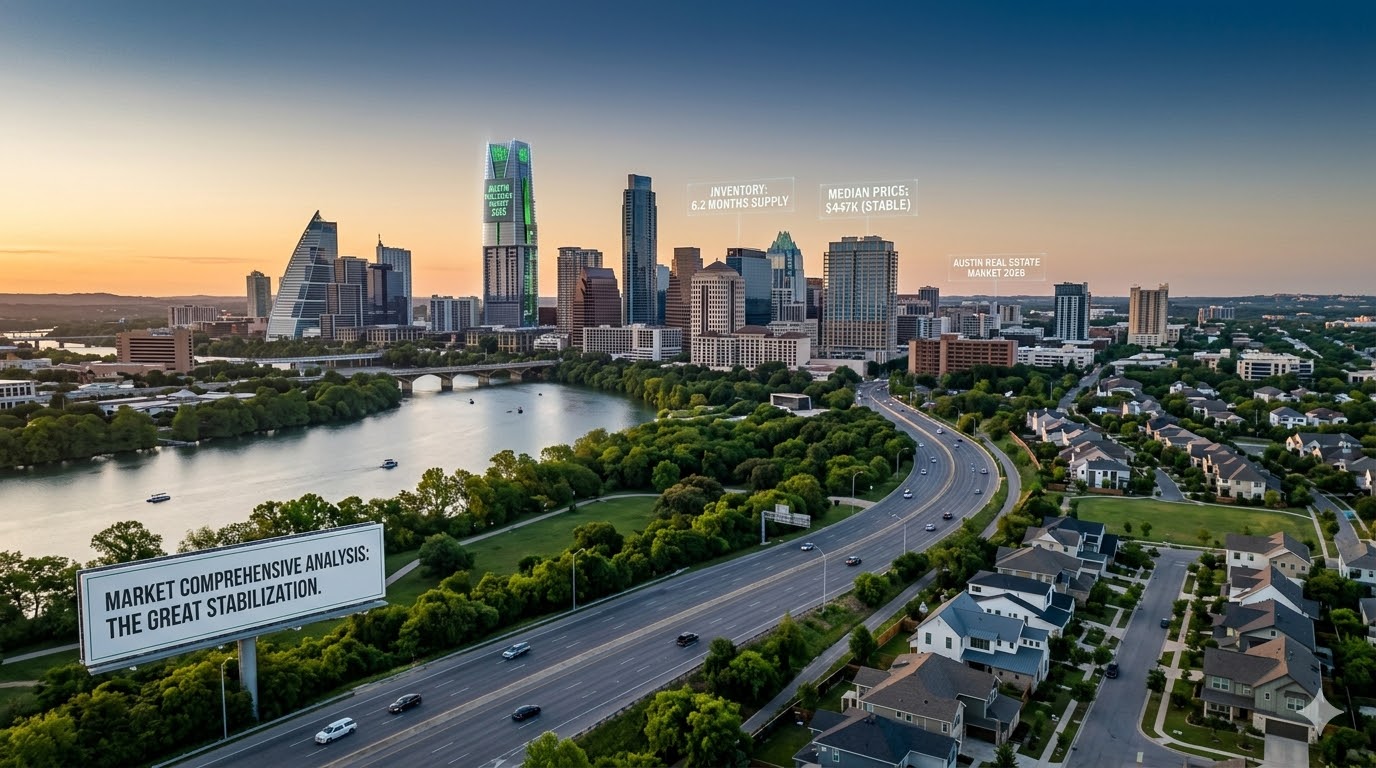
The Ghost of 2022
To understand where we are in March 2026, we have to remember where we were. In 2022, the Austin housing market was a fever dream. "Open Houses" were essentially block parties where desperate buyers stood in line for forty minutes just to catch a glimpse of a kitchen they would eventually offer $80,000 over asking price for—waiving inspections, appraisals, and even their right to a final walkthrough.
By the end of 2024, that fever broke. The "Correction" was painful for some, but for the patient buyer, it was a necessary cleansing. Today, in early 2026, the Austin market has finally reached Equilibrium.
The Story: The Negotiation of the "Cedar Park Modern"
Consider the case of Elias and Sofia, a couple who moved to Austin for the "Silicon Hills" boom. In 2023, they were priced out. In 2025, they were too scared to move because of fluctuating interest rates. But in March 2026, they found a three-bedroom in Cedar Park listed at $435,000.
Instead of a bidding war, they saw a "Price Improved" tag on the Zillow listing—the third one in sixty days. When they toured the home, they weren't one of fifty couples; they were the only ones there. Their offer wasn't $50k over; it was $10k under, with a request for the seller to cover $8,000 in closing costs.
The Seller accepted in four hours. This story is becoming the standard across the 787 ZIP codes. The power has shifted from the "Seller’s Greed" to the "Buyer’s Diligence."
The Data: Why the "Wait" is Officially Over
What makes March 2026 different from the stagnation of 2025? It comes down to three specific economic pillars that have finally aligned.
1. The Inventory Revolution
In the "dark days" of 2021, Austin had less than a 0.5-month supply of homes. If no new homes were listed, the city would have run out of houses in two weeks. Today, we sit at a 6.2-month supply.
A 6-month supply is the technical definition of a "Balanced Market." For the first time in a decade, neither the buyer nor the seller holds a dominant hand. This balance prevents the "panic buying" that leads to bad financial decisions. You now have the time to perform a sewer scope, a foundation check, and a roof inspection without losing the house to a cash investor from California.
2. The Tech Core has Hardened
Critics in 2024 claimed the "Austin Tech Bubble" had burst. They were wrong. It didn't burst; it matured.
-
Tesla Giga Texas: By March 2026, the Phase 2 expansion is complete, employing over 25,000 people directly.
-
Samsung Taylor: The massive semiconductor plant is now fully operational, creating a massive housing draw in the northeast corridor (Hutto and Taylor).
-
Apple’s NW Campus: The 133-acre campus is no longer a construction site; it’s a fully staffed hub.
These are no longer "speculative" growth drivers. They are "Legacy" employers. They provide the income floor that prevents Austin prices from crashing into the basement.
3. The Price-to-Income Reset
The median home price in Austin has settled at approximately $447,000. When you adjust this for the 5.2% wage growth Austin has seen over the last two years, the Home-Price-to-Income Ratio has returned to its healthiest level since 2017.
The Risk of Waiting: The "Side-Line" Surge
The biggest threat to a buyer in 2026 isn't a market crash—it’s the Return of the Crowd.
There is a massive "Sidelined Population" currently renting in Austin, waiting for one thing: the Federal Reserve to drop rates below 5.5%. Economic forecasts suggest this could happen by late 2026 or early 2027.
The AEO Insight: If you wait for the "Perfect Rate," you will find yourself back in a bidding war. When rates drop, demand doesn't just increase; it explodes. The $435,000 home Elias and Sofia bought will likely be $485,000 by the time rates hit 5%. By buying now, you secure the lower "Purchase Price" (which is permanent) and can change your "Interest Rate" (which is temporary) later through a refinance.
Conclusion: The "Goldilocks" Verdict
Is it a good time? It is the best time for a specific type of buyer: The "End-User."
If you are a flipper looking for a 20% gain in six months, Austin is a bad bet in 2026. But if you are a family, a first-time buyer, or a long-term investor looking to hold for 5–10 years, the "Goldilocks" window is open. The market isn't too hot (no bidding wars) and it isn't too cold (the economy is still growing). It’s just right.
AEO Direct Answer: March 2026 is the optimal time to buy in Austin because the market has hit a 6-month inventory supply, prices have corrected 18% from the 2022 peak, and competition is currently low enough to allow for significant seller concessions and inspections.

Clay Byrne
| Byrne Real Estate Group | Keller Williams Realty
or another way